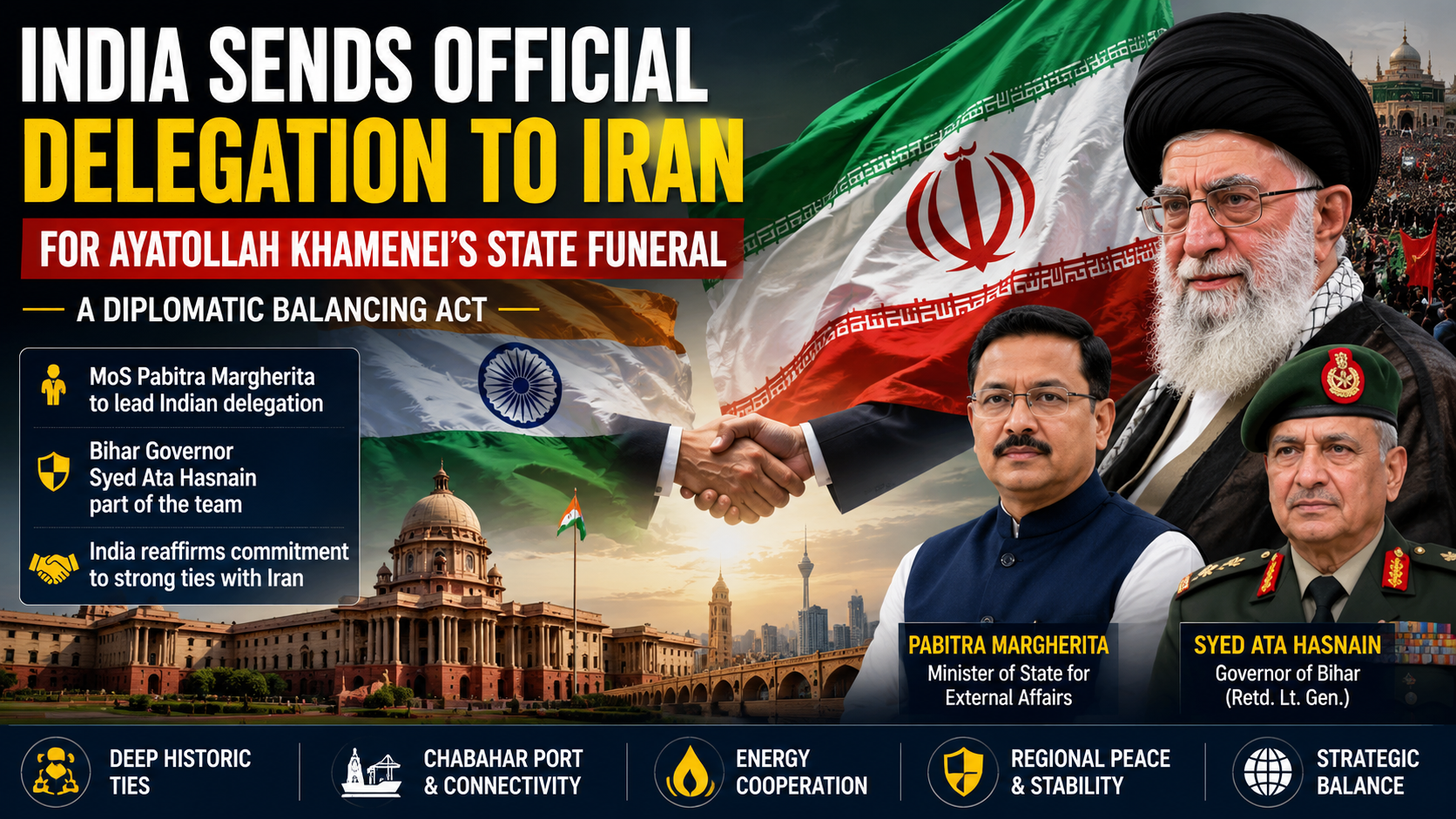
India has announced that an official delegation will attend the state funeral of Iran’s late Supreme Leader, Ayatollah Ali Khamenei, highlighting New Delhi’s commitment to maintaining long-standing diplomatic ties with Tehran while carefully balancing its strategic relationships across the Middle East. According to government and diplomatic sources, Union Minister of State for External Affairs Pabitra Margherita and Bihar Governor Lt. Gen. (Retd.) Syed Ata Hasnain will represent India at the ceremony.
The decision comes at a time of heightened geopolitical tensions in West Asia. India has consistently advocated dialogue, peace, and regional stability while maintaining strong relationships with Iran, Israel, Gulf nations, and Western partners. Sending an official delegation reflects India’s nuanced foreign policy, which seeks to preserve strategic partnerships without becoming entangled in regional conflicts.
Strengthening a Historic Relationship
India and Iran have shared centuries-old cultural, economic, and diplomatic ties. Modern relations have been shaped by cooperation in energy, connectivity, trade, and regional security.
Iran has been an important energy supplier to India and plays a strategic role in New Delhi’s vision for greater connectivity with Central Asia through the Chabahar Port. Despite international sanctions and changing geopolitical dynamics, both countries have continued diplomatic engagement.
By participating in the state funeral, India is signalling respect for bilateral relations while acknowledging Iran’s importance in regional affairs.
Why India Chose an Official Delegation
Prime Minister Narendra Modi is not attending the ceremony personally. Instead, the government has opted to send senior representatives, a move widely viewed by analysts as a carefully calibrated diplomatic decision.
Union Minister of State for External Affairs Pabitra Margherita represents India’s diplomatic establishment, while Bihar Governor Lt. Gen. (Retd.) Syed Ata Hasnain brings extensive strategic and defence experience.
This approach enables India to express condolences and maintain diplomatic protocol without altering its broader foreign policy balance in the Middle East.
India’s Balancing Strategy in West Asia
Over the past decade, India has significantly strengthened ties with Israel, Saudi Arabia, the UAE, Qatar, and other Gulf nations while preserving its relationship with Iran.
This balancing strategy has become one of the defining features of India’s foreign policy.
India’s interests in the region include:
- Energy security
- Trade and investment
- Maritime security
- Protection of the Indian diaspora
- Counter-terrorism cooperation
- Regional stability
Maintaining cordial relations with all major regional powers allows India to protect these strategic interests.
Strategic Importance of Iran
Iran occupies a critical geographical position connecting South Asia, Central Asia, and Europe.
Projects such as the Chabahar Port and the International North-South Transport Corridor (INSTC) are expected to improve India’s access to Central Asian markets while reducing dependence on traditional trade routes.
Iran also remains important for India’s long-term energy diversification strategy, even as global energy markets evolve.
Diplomatic engagement therefore remains an important pillar of bilateral cooperation.
Regional Implications
The funeral takes place amid continuing uncertainty in West Asia.
Developments involving Iran continue to influence:
- Global oil prices
- Maritime trade through the Strait of Hormuz
- International energy markets
- Regional security
- Diplomatic negotiations involving major world powers
As one of the world’s fastest-growing major economies, India has a strong interest in regional peace and uninterrupted energy supplies.
Its diplomatic outreach reflects these broader national priorities.
India’s Independent Foreign Policy
India has increasingly emphasized strategic autonomy in international affairs.
Rather than aligning exclusively with any single bloc, New Delhi has sought to engage multiple partners based on national interest.
This approach has enabled India to maintain productive relationships with countries that often have competing geopolitical interests.
The decision to send a delegation to Iran reflects this independent foreign policy tradition.
International Reactions
Observers have described India’s decision as measured and pragmatic.
Many countries are carefully calibrating their diplomatic responses to developments in Iran, and India’s participation through an official delegation is viewed as consistent with established diplomatic practice.
The move also reinforces India’s image as a country capable of maintaining dialogue across diverse geopolitical partnerships.
Looking Ahead
India is expected to continue engaging Iran on issues related to trade, connectivity, regional security, and energy while simultaneously deepening cooperation with Israel, the Gulf states, the United States, and European partners.
As global geopolitics become increasingly complex, India’s ability to maintain balanced relationships with multiple stakeholders is likely to remain one of its greatest diplomatic strengths.
The participation of an official delegation at Iran’s state funeral is therefore not merely ceremonial—it reflects India’s broader vision of strategic engagement, diplomatic continuity, and regional stability.
Conclusion
India’s decision to send an official delegation to Ayatollah Khamenei’s state funeral demonstrates the country’s commitment to preserving important bilateral relationships while maintaining its carefully balanced foreign policy.
By choosing experienced representatives instead of the Prime Minister, New Delhi has conveyed respect for Iran while reinforcing its strategy of engaging all major regional partners through diplomacy, dialogue, and mutual respect.
Source Links
- India to send official delegation to Ayatollah Khamenei’s funeral (Times of India).
- Indian Express – June 30 national headlines.