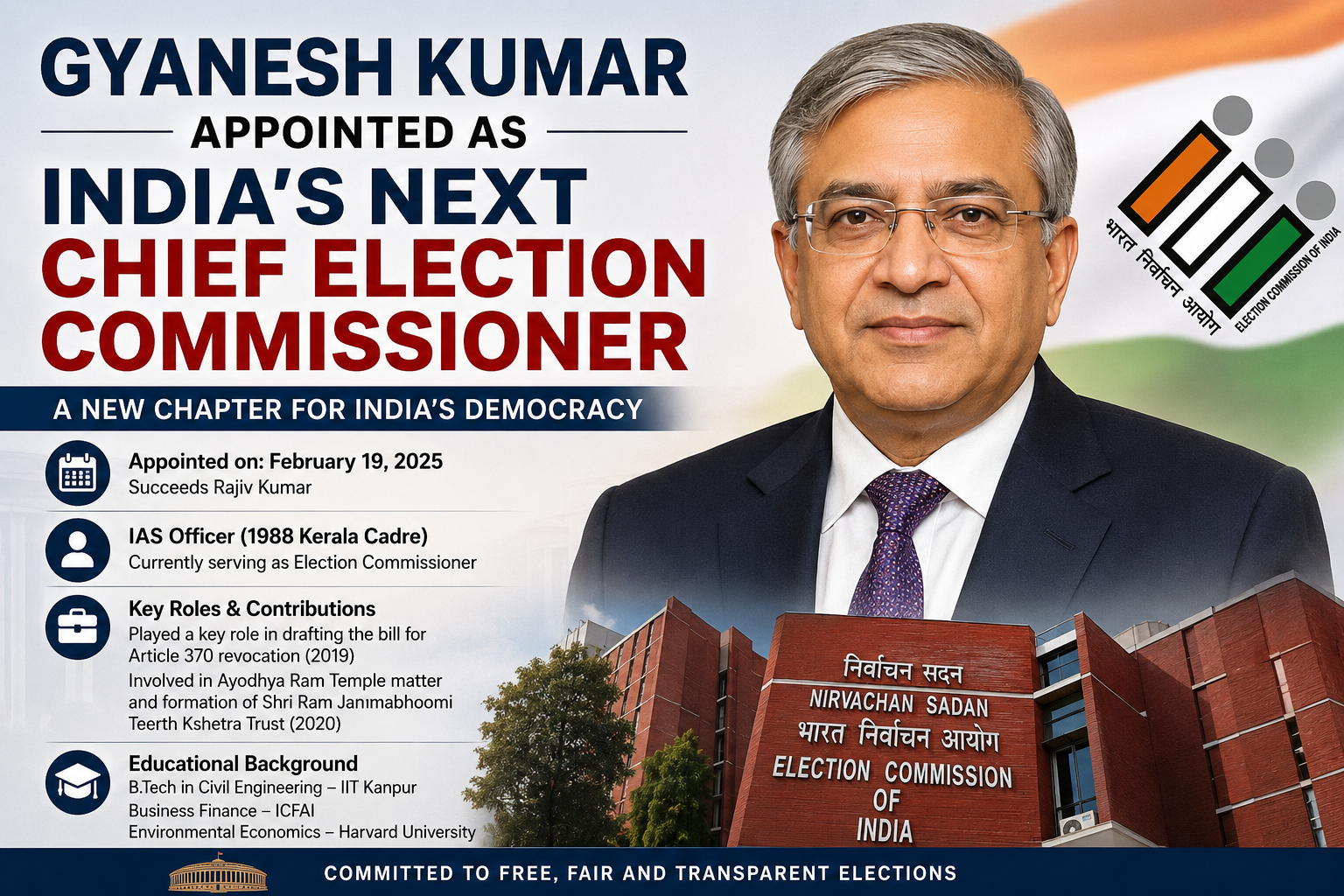
India has appointed Gyanesh Kumar, a senior Indian Administrative Service (IAS) officer from the 1988 Kerala cadre, as the country’s next Chief Election Commissioner (CEC). He succeeds Rajiv Kumar, who completed his tenure after overseeing several major electoral processes across the nation.
Currently serving as an Election Commissioner, Gyanesh Kumar is the senior-most member of the three-member Election Commission panel. His appointment comes at a crucial time as India prepares for several important elections in the coming years.
Key Elections Under His Leadership
As Chief Election Commissioner, Gyanesh Kumar will oversee several significant electoral events, including:
- Bihar Assembly Elections 2025
- West Bengal Assembly Elections 2026
- Assam Assembly Elections 2026
- Tamil Nadu Assembly Elections 2026
His leadership is expected to play an important role in ensuring transparent, fair, and efficient election processes across the country.
Distinguished Administrative Career
With decades of experience in public administration, Gyanesh Kumar has held several influential positions within the Government of India.
One of his most notable contributions came in 2019 when he played a key role in drafting the legislation related to the revocation of Article 370 in Jammu and Kashmir. At the time, he served as Joint Secretary in the Kashmir Division of the Union Home Ministry.
In 2020, as Additional Secretary in the Ministry of Home Affairs, he was involved in handling important administrative matters related to the Supreme Court’s Ayodhya verdict and contributed to the formation of the Shri Ram Janmabhoomi Teerth Kshetra Trust.
Strong Academic Background
Gyanesh Kumar’s educational achievements reflect his diverse expertise in governance, finance, and public policy.
His academic qualifications include:
- B.Tech in Civil Engineering from IIT Kanpur
- Studies in Business Finance from the Institute of Chartered Financial Analysts of India
- Environmental Economics studies at Harvard University
This combination of technical, financial, and policy knowledge has helped shape his distinguished administrative career.
A New Chapter for India’s Electoral System
As India continues to strengthen its democratic institutions, Gyanesh Kumar’s appointment marks a significant transition for the Election Commission. With extensive administrative experience and a proven record in governance, he is expected to guide the country’s electoral machinery through some of the most important elections in the coming years.
His leadership will be closely watched as India prepares for a busy electoral calendar, reinforcing the country’s commitment to free, fair, and transparent democratic processes.
Conclusion
The appointment of Gyanesh Kumar as India’s next Chief Election Commissioner highlights the government’s confidence in his administrative expertise and leadership capabilities. As he assumes office, his experience and institutional knowledge are expected to contribute significantly to maintaining the integrity and efficiency of India’s electoral system.