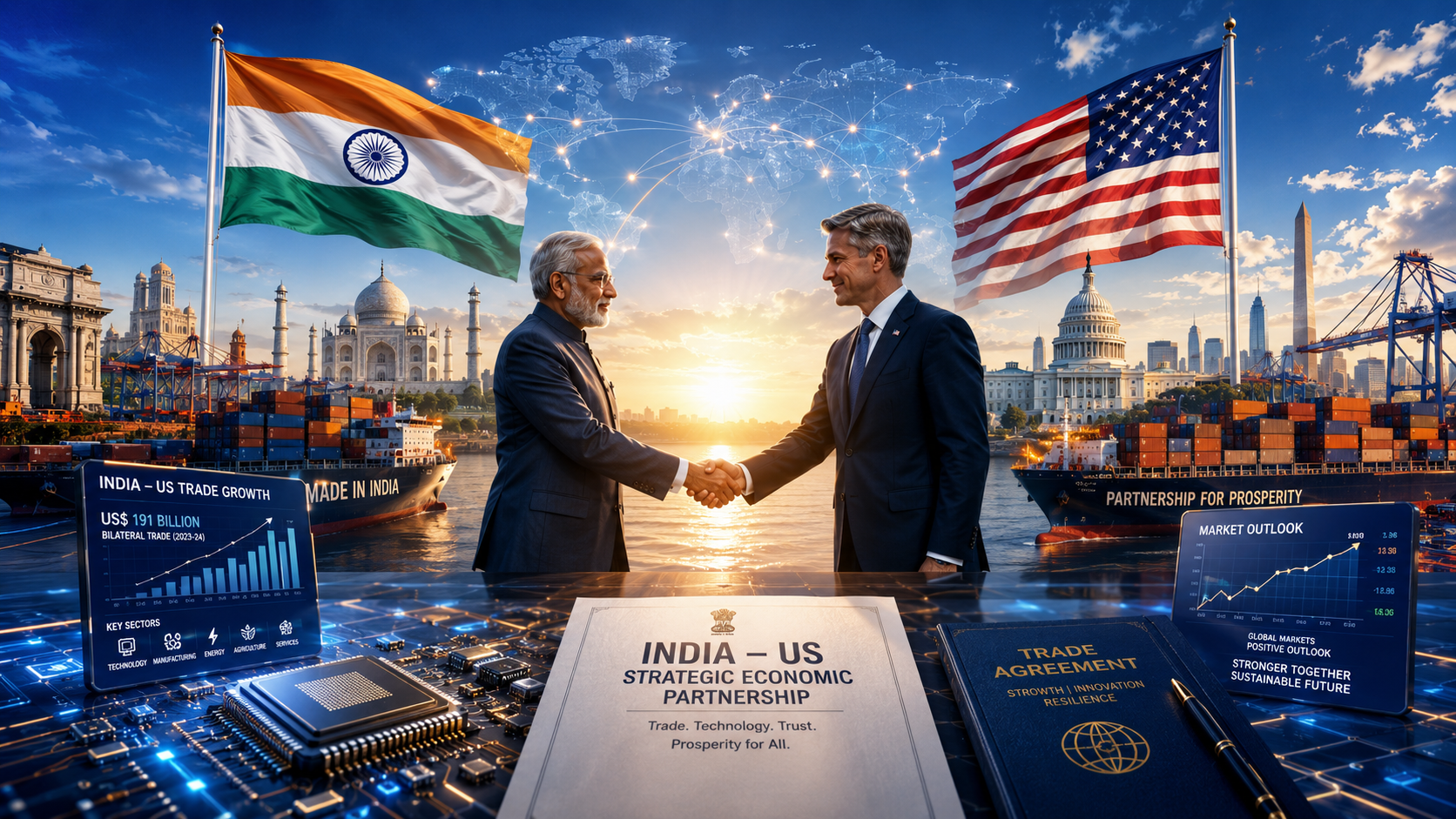
India and the United States are moving closer to finalizing a long-awaited bilateral trade agreement, marking a significant milestone in one of the world’s most important strategic partnerships. Senior officials from both countries have intensified negotiations in recent weeks, aiming to resolve key issues related to tariffs, market access, digital trade, agriculture, and manufacturing before announcing the first phase of the agreement.
The proposed trade deal is expected to strengthen economic ties between the world’s largest democracy and the world’s largest economy. Analysts believe the agreement could boost bilateral trade, attract fresh investments, create employment opportunities, and strengthen supply chain resilience amid an evolving global economic landscape.
The discussions come at a time when both nations are seeking to diversify supply chains, enhance technology cooperation, and deepen strategic collaboration across multiple sectors.
A Growing Strategic Partnership
India and the United States have steadily expanded their relationship over the past two decades. What began primarily as a diplomatic partnership has evolved into cooperation across defence, technology, healthcare, renewable energy, education, and trade.
Bilateral trade has grown significantly, making the United States one of India’s largest trading partners. Both governments now view economic cooperation as a key pillar of their broader strategic relationship.
The proposed agreement aims to reduce trade barriers while encouraging businesses from both countries to invest in new sectors.
Key Areas Under Negotiation
Negotiators are currently focusing on several important issues, including:
- Reduction of import tariffs
- Greater market access for agricultural products
- Expansion of digital trade
- Medical devices and pharmaceutical regulations
- Manufacturing cooperation
- Semiconductor supply chains
- Intellectual property protection
- E-commerce regulations
Officials hope that resolving these issues will create a more predictable business environment for companies operating in both markets.
Benefits for India
If finalized, the agreement could provide significant advantages for India’s economy.
Indian exporters may gain improved access to one of the world’s largest consumer markets, benefiting industries such as:
- Information Technology
- Pharmaceuticals
- Textiles
- Engineering Goods
- Electronics
- Auto Components
- Agriculture
The agreement could also encourage multinational companies to expand manufacturing operations in India under the government’s “Make in India” initiative.
Greater foreign investment would support job creation while strengthening India’s position as a global manufacturing hub.
Benefits for the United States
American businesses are also expected to benefit through improved access to India’s rapidly growing consumer market.
India’s expanding middle class offers substantial opportunities for companies in sectors such as:
- Technology
- Healthcare
- Renewable Energy
- Financial Services
- Consumer Goods
- Education
- Aviation
Closer economic cooperation could further strengthen supply chains that have become increasingly important following global disruptions in recent years.
Technology and Innovation at the Centre
Technology cooperation has emerged as one of the strongest aspects of India-US relations.
Both countries are collaborating on:
- Artificial Intelligence
- Semiconductor manufacturing
- Quantum computing
- Space technology
- Cybersecurity
- Telecommunications
- Digital public infrastructure
The trade agreement is expected to provide additional support for innovation-driven industries.
Challenges Still Remain
Despite substantial progress, several complex issues remain under discussion.
Agricultural market access continues to be one of the most sensitive areas, with both countries seeking to protect domestic farmers while expanding trade opportunities.
Digital taxation, data governance, intellectual property rights, and regulatory standards also require further negotiations.
Trade experts believe compromise from both sides will be essential to achieve a balanced agreement.
Geopolitical Significance
Beyond economics, the proposed trade agreement carries considerable geopolitical importance.
As global supply chains shift and countries seek to reduce dependence on single manufacturing centres, India has emerged as an increasingly attractive destination for investment.
Strengthening economic cooperation with the United States supports India’s broader strategy of becoming a major global manufacturing and technology hub.
The agreement also complements growing cooperation under initiatives such as the Quad and the India-US Initiative on Critical and Emerging Technology (iCET).
Impact on Businesses
Businesses across multiple sectors are closely monitoring the negotiations.
Exporters anticipate lower trade barriers, while investors expect greater policy certainty if the agreement is finalized.
Industry bodies have welcomed continued dialogue, noting that stronger economic integration could improve competitiveness and encourage long-term investment.
Small and medium enterprises may also benefit through increased export opportunities and improved access to international markets.
Looking Ahead
Officials from both governments remain optimistic that remaining issues can be resolved through continued negotiations.
Even if a comprehensive agreement takes additional time, many experts expect an initial or phased trade package to be announced in the coming months.
Such a development would represent one of the most important milestones in India-US economic relations in recent years.
Conclusion
The ongoing India-US trade negotiations reflect the growing importance of economic cooperation between two of the world’s largest democracies.
A successful agreement could strengthen bilateral trade, attract investment, support innovation, create employment, and enhance supply chain resilience while reinforcing the broader strategic partnership between New Delhi and Washington.
Although some challenges remain, the momentum behind the negotiations suggests that both countries recognize the long-term benefits of deeper economic integration. If finalized, the agreement could shape the future of Indo-US trade and contribute significantly to global economic growth.
Source Links
- Reuters – India and US continue negotiations on bilateral trade agreement: https://www.reuters.com/
- The Economic Times – India-US trade deal updates: https://economictimes.indiatimes.com/
- Ministry of Commerce & Industry, Government of India – https://commerce.gov.in/